Who do you remember, and how do you remember them? As I sit in my brother’s apartment near Rochester, New York, these questions are at the forefront of my mind. This week, my brother Murray passed away. I’ve spent the past week with him, visiting the hospice home where he spent his final days.
I’m grateful to have spent this time with him, seeing facets of his life and character that I had not previously perceived. As his older sibling, I clearly underestimated his life experiences and abilities. This past week has been a bittersweet blend of mourning and discovery, amplified by hearing how profoundly he impacted those around him.
A Poet and Caregiver
At the funeral home, while filling out paperwork for Murray’s death, the director posed a crucial question: “What was his profession?” Without hesitation, I answered, “He’s a poet and a writer.” The conversation highlighted that, despite his various jobs to sustain himself, Murray’s essence was found in his words. Murray also played a vital role as a caregiver—first in Southern California for disabled individuals and later for our parents during their final years. But above all, a poet is what he was.
Building Community Through Creativity
Murray had an extraordinary gift for building and nurturing community, a talent I didn’t fully appreciate until now. A friend from Southern California sent a card that read, “Just remembering how you came on the poetry scene like a lion and helped the rest of us together on top of it.” This single sentence shed new light on his influence within the Los Angeles poetry community—a vast and vibrant group of poets whom he loved and by whom he was loved in return.
In his later years in Rochester, Murray built a loving, supportive community. A local open mic host shared that, while Murray would read just three poems, he touched many lives through his humility and respect for others. This openness to collaboration and shared creativity formed the cornerstone of his community-building efforts.
Saying Goodbye
During my extended stay, there was a poignant moment with my sister, who was away on a long-planned trip. Murray had assured her, “You have to go,” despite the likelihood he would pass in her absence. On an afternoon call, she asked me to convey her love and permission for him to let go. That night, Murray passed away peacefully, perhaps reassured by the love surrounding him.
Final Thoughts
I regret not knowing Murray more deeply before saying goodbye. Despite geographical and lifestyle distances—he in Southern California, me in Michigan—I am left pondering the depths of his life I barely brushed. I hope that my reflections can serve as a reminder to get to know your loved ones before farewells become necessary.
I extend heartfelt gratitude to my friends from the recovery program and a loving higher power for support during this time. My recovery has equipped me to navigate this loss without crumbling.
Epilogue: The Poetry God
I close with an excerpt from one of Murray’s poems, “The Poetry God”:
The poetry God
rises from the dead
every day.
He tells glorious tales of the afterlife.
We nod politely
as if listening to a friend
describe an incomprehensible dream.
The poetry God
dies
every night.
May Murray’s spirit live on through his words and the lives he’s touched.
Transcript
[00:00:00] Spencer: Who do you remember and how do you remember them? Welcome to an interim episode of The Recovery Show. I’m currently sitting in my brother’s apartment, near Rochester, New York. He died earlier this week, and I’ve been with him for about the last week of his life, visiting and sitting with him in the hospice home where he was for that period.
[00:00:31] If you’re a regular listener to The Recovery Show, you will have heard some of my feelings and reactions to his disease as it appeared and progressed. Th-those will be coming in some future Recovery Show episodes because those episodes were recorded before today, before this visit.
[00:01:00] I am grateful to have had this time with him, and to discover, or have amplified, things about my brother that I did not see prior to now. You know, he is my younger brother by a couple of years, and I think because of that, I probably discounted his life experience, his abilities. The last week has been both a time of sadness and mourning, but also a time of discovery and joy as people in his life have expressed to me, or to him, how important and what an impact he had on their lives.
[00:02:08] My brother Murray is a poet and a writer. I was meeting with the funeral home director earlier this week to fill out paperwork relating to his death, because that has to happen. We were filling out the death certificate and she asked, “What was his profession?” I said, “He’s a poet and a writer.” She said, “Yeah, but what was his profession?” I described a few of the jobs he had had so that he would have money to live on while he pursued his passion for poetry and for writing. And in the end, we wrote poet in the profession blank, because that was what he was. He was not defined by any of the other jobs that he had had, except possibly the last job that he had, which was that of caregiver.
[00:03:11] He was first a caregiver for disabled people in the Southern California area where he lived in the Los Angeles area. And then, as you’ve probably heard in earlier episodes of this podcast, he was a caregiver for my parents in the last few years of their lives. But poet is what he was.
[00:03:34] Another thing about my brother that I didn’t hear, that I didn’t understand, was his ability to create community and to help it flourish. I want to read an excerpt here from a card he got from one of his Southern California friends, who wrote, ” Just remembering how you came on the poetry scene like a lion and helped the rest of us together on top of it.” I knew that he was active in the Los Angeles area poetry community, but that single sentence really highlighted for me his impact there. And LA is not a small place, there are a lot of poets in the Los Angeles area, and he was known to and knew many of them. He loved them and they loved him.
[00:04:36] He moved into this apartment, his final living place, only about four years ago, and in that time, he built around him such a large and loving community. I heard from so many people in the last week and in the last month or so. About how they loved him and what an impact he had had on their lives
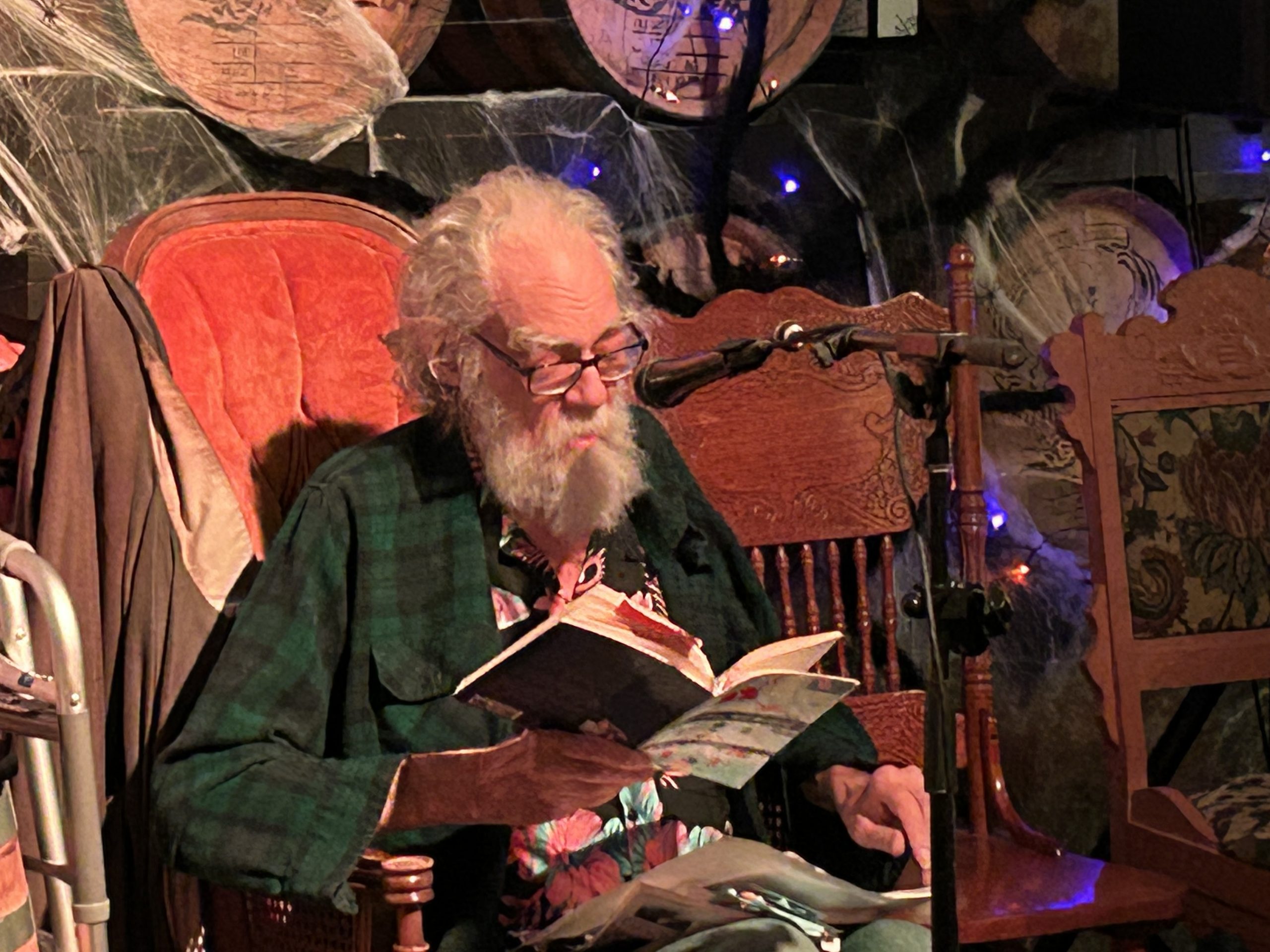
[00:05:02] One of his friends I sat and talked with for a little while. This fellow runs a local open mic, and he said, “You know, when Murray would read, he would read three poems, and he would sit down.” The fellow said, “I would encourage him to read more, but that was him. He did not put himself out, did not put himself in front of or above anybody else.” And I think that was a huge part of how he built community because he respected everybody else.
[00:05:40] When I arrived here after a all-day drive from home, I went into the hospice home where he was living his last days, at that time he was sitting up, he was lucid and vocal,and we had some good conversation and just some time sitting together. As the days passed, he got weaker, could no longer sit up in a chair. Came to the last couple of days where he was not very communicative, not very responsive. In the last day, he seemed to be sleeping peacefully, which was a blessing.
[00:06:23] My sister, who is on a long-planned trip in which my brother said, “You have to go,” even though there was a strong possibility that he would pass while she was away, and indeed, that did happen. But, Tuesday afternoon, I had a phone conversation with her, and she said To tell him that she loved him and that it was okay for him to go. He didn’t need to wait for her to get back. I passed that message on to him, and that night is when he died. And I believe that he needed permission from the people who loved him to leave.
[00:07:04] I wish I had somehow known him better before this ending. You know, I’ve known him all his life, all sixty-nine years of it. Yes, we lived far apart for a good part of that time when he was in Southern California and I was in Michigan. But we did see each other probably about once a year. I got to see some little slices of his life. But there’s so much that I have known but not known deeply about him.
[00:07:41] So if you’re still listening to the end of this somewhat rambling reminiscence, I encourage you to get to know your loved ones as well as you can, before it comes time to say goodbye.
[00:07:56] I am immensely grateful for the support of my friends in this program of recovery and for the support of a loving higher power that I found here. I’m so grateful that I’ve had this time in recovery because it has made it more possible for me to live through this experience without falling apart.
[00:08:21] I want to finish with an excerpt from a poem of his titled “The Poetry God.”
[00:08:28] The poetry God
[00:08:29] rises from the dead
[00:08:31] every day.
[00:08:33] He tells glorious tales of the afterlife.
[00:08:38] We nod politely
[00:08:40] as if listening to a friend
[00:08:42] describe an incomprehensible dream.
[00:08:46] The poetry God
[00:08:47] dies
[00:08:49] every night.
Dear Spencer
Hearing your beautiful reflection on the eve of all hallows has opened my heart. This is a time of year when the veils between the worlds of the living and the dead are thin, allowing wonderful exchanges between the two. Thank you for allowing us to accompany you in your remembrance of your brothers peaceful death and his life of commitment to his gifts as poet and creator of communities and care giver. At times of wakefulness during the wee hours I regularly play your podcast. Often I fall back to sleep quickly, because it’s as if I can surrender to the knowledge that the work of recovery can continue as I sleep. There are thousands of us across the world, upholding you in the light of love as you move through these days. I suspect that your relationship with your dear brother will continue to grow in the respect and passion of creating spaces for community which ye clearly share. May he rest in peace.