
Barb and Spencer explore the vital topic of boundaries in depth, offering insights into how establishing and maintaining boundaries can significantly impact one's emotional well-being. Barb, a boundaries coach, shared personal experiences and wisdom gained from her own recovery journey, shedding light on how boundaries play a critical role in understanding oneself and improving relationships with others.
The Importance of Boundaries
Barb emphasized that boundaries act as standards and limits for maintaining one’s own life and interaction with others. They protect personal resources such as time, energy, and emotional availability. Learning to establish boundaries is part of a lifelong process, and it often begins with self-examination. Barb shared an example of her decision to not allow smoking in her home, illustrating how boundaries can manifest in everyday situations to uphold personal health standards.
Creating Internal Safety Through Boundaries
A key takeaway is the idea that building boundaries is a gradual, experimental process. Barb explained that people often struggle with setting boundaries due to the emotional challenges they face, such as guilt and shame. By starting with oneself, individuals can gain clarity on what is acceptable and unacceptable, without the added pressure of involving others initially.
Barb shared how her journey of self-discovery through boundaries led her to become emotionally available to herself. She realized that many of her past relationships were with emotionally unavailable people, mirroring her own emotional unavailability. Through her recovery, she identified and dismantled her codependence, constructing internal safety by creating secure attachments to herself rather than relying on the approval of others.
The Journey of Integration and Self-Discovery
For both Barb and Spencer, working the 12 steps was integral in this process of self-discovery. This framework allowed them to identify character traits and behaviors, which they learned to view not as defects, but as habits they could choose to change. This perspective helped diminish any associated stigma and opened up paths for personal growth and self-acceptance.
Spencer shared his experiences with setting boundaries in his life, particularly in relation to how he consumes news and interacts with individuals who demand more of his time than he can give. By understanding his limitations and what affects his emotional state, he effectively manages the information he chooses to take in and the requests for help he receives.
Building Boundaries: A Personal Exploration
Ultimately, Barb emphasized that understanding and establishing boundaries is more about respecting personal limits and less about controlling others. The journey involves consistent self-reflection, experimentation, and a willingness to honor personal needs and desires. By regularly asking themselves what they want or need in various situations, individuals can gradually develop a lifestyle aligned with their true selves, rather than societal expectations.
Both Barb and Spencer highlighted that this journey of personal growth through boundary setting is ongoing, with continual learning and adaptation. The time invested in understanding oneself and building boundaries is invaluable, leading to a greater sense of peace, self-respect, and empowerment in facing life’s challenges.
Readings and Links
Barb shared the September 5 reading from Voices of Recovery: A Daily Reader from Overeaters Anonymous.
Barb has a podcast, Fragmented to Whole.
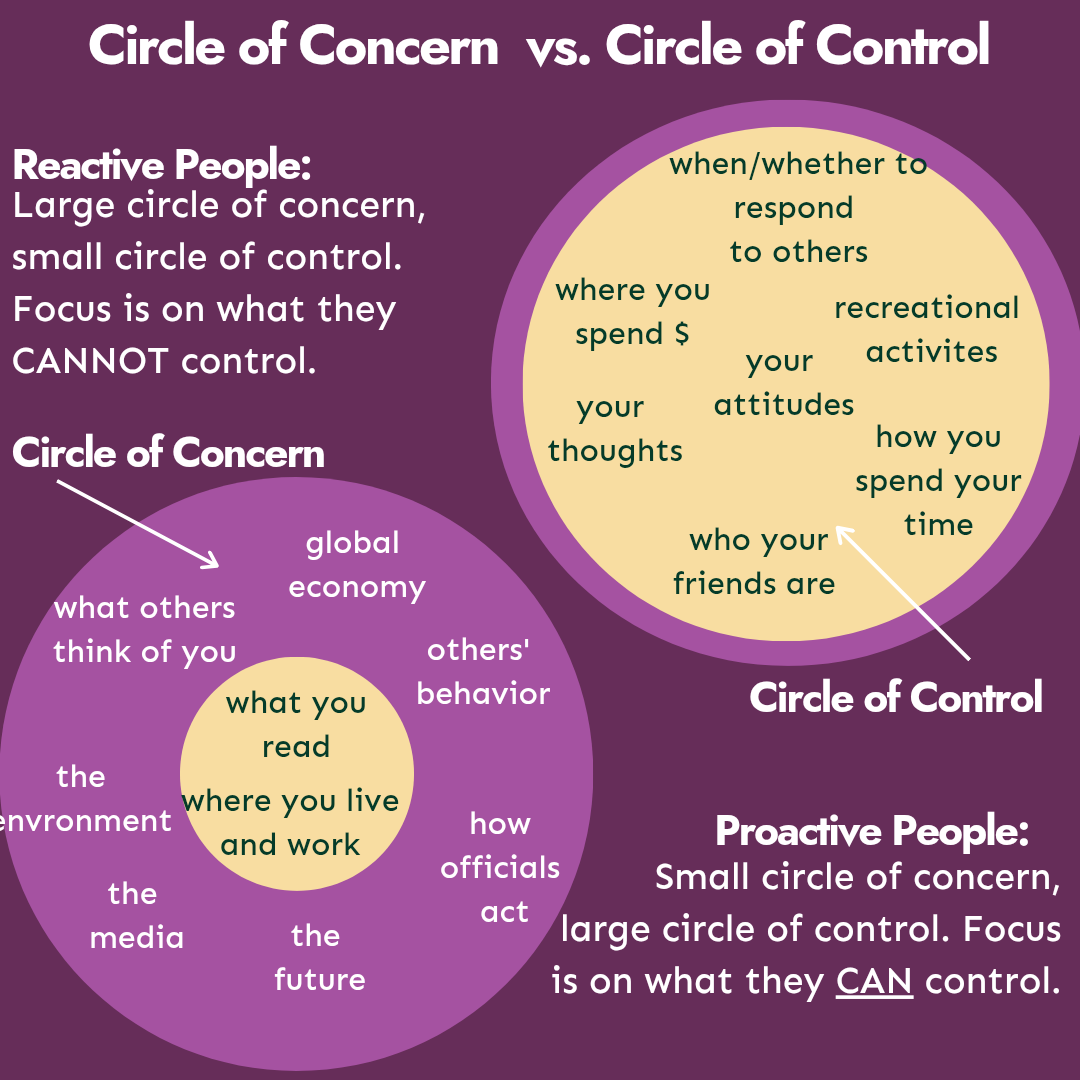
Barb talked about circles of concern and circles of control. She sent this diagram to help us understand how these show up in our lives.
Upcoming topics
We are planning an episode on sponsorship, prompted by some email questions from a listener, who said, I'd like to hear more about sponsorship. How do you choose a sponsor? How does the whole sponsor thing work anyway? Please call us at 734-707-8795 or email feedback@therecovery.show with your questions or experience, strength and hope. Or just leave a comment right here.
Transcript
Intro
[00:00:01] Spencer: How do healthy boundaries create internal safety?
[00:00:05] Welcome to episode 448 of the Recovery Show. This episode is brought to you by Julie, David and Jennifer. They used the donation button on our website. Thank you, Julie, David, and Jennifer for your generous contributions. This episode is for you.
[00:00:21] We are friends and family members of alcoholics and addicts who have found a path to serenity and happiness. We who live or have lived with the seemingly hopeless problem of addiction. Understand as perhaps few others can. So much depends on our own attitudes and we believe that changed attitudes can aid recovery.
[00:00:38] Barb: Before we begin, we would like to state that in this show we represent ourselves rather than any 12 step program. During this show, we will share our own experiences. The opinions expressed here are strictly those of the person who gave them.
[00:00:51] Take what you like and leave the rest. We hope that you'll find something in our sharing that speaks to your life.
[00:00:58] Spencer: My name is Spencer and I am your host. Joining me today is Barb. Welcome back to the Recovery Show. Barb, I see that you were last here in episode 396 titled Boundaries Revisited in March, 2023, so almost three years ago.
[00:01:16] Barb: And welcome back
[00:01:17] Thank you so much. I'm really excited to be here. Some big changes have happened for me in terms of realizations and the work that I do. And I thought it might bring value to your listeners to share what I've learned.
[00:01:31] Spencer: Yeah. Your work really is centered in boundaries, right?
[00:01:35] Barb: Boundaries coach.
Boundaries and Internal Safety
[00:01:37] Spencer: We like to open with a reading. what did you bring?
[00:01:41] Barb: I brought the September 5th reading from the OA Voices of Recovery Daily Reader. And I have to tell you, when I read this on September 5th, 2016, it changed everything for me. It starts with a quote from the OA 12 and 12, or the 12 steps in 12 traditions of Over eaters Anonymous.
[00:02:02] Clearly, if we were going to remain abstinent and find serenity, we had to learn better ways of dealing with other people, ways that would bring us joy instead of pain.
[00:02:11] So that's the end of the quote. And then here's the reading.
[00:02:15] Learning better ways of dealing with other people is a lifelong process and a challenge. Yet I've learned things in OA that have helped. The first is acceptance. I had all sorts of expectations about others' abilities and behavior. I expected people to be competent, capable, and productive. I expected them to behave rationally and to be true to their word. These are my expectations for myself, and I've had to let go of them for others. I'm still disappointed when someone doesn't follow through on a commitment, but I don't let it ruin my serenity.
[00:02:48] I've also learned that I don't have to prove I'm right. I can silently agree to disagree. I put aside my pride, acknowledge another's point by saying, you may be right and gracefully walk away from a situation. Finally, I look for the good in people. Sometimes it requires quite a stretch, but the stretch is worth it. Focusing on the bad brings pain. The joy comes in finding the good, I'd rather have the joy.
[00:03:18] Spencer: Talk to me about that reading.
[00:03:20] Barb: At the time I was about six months into OA and I was about a year and a half into my other program, ACA. I was probably working on step four, and I was working for a woman who at that point in time, I'd been working for her for 17, 18 years. I loved her dearly, but she drove me crazy. And this is why. Because I expected her to be capable, competent, and productive, behave rationally and true to her word. That was the main thing, that she was very unreliable. And I had been blaming her for my distress. This reading helped me to understand what acceptance actually means. It doesn't mean you like what is happening, it's that you stop fighting against it. And that you also realize that this is one of those things that I get to get the courage to change. I have the wisdom to know that this is something I can change.
[00:04:17] So it's my mindset. My mindset was she should be different and she's not. The idea that I could silently agree to disagree was amazing. When I read the words, I also learned, I don't have to prove that I'm right. I saw myself in a way that I don't think I ever had.so this reading is something that really, really shifted things for me. Because, it just described exactly what I was going through. Using words that just somehow, you know how sometimes a reading really hits you and sometimes it doesn't. Well, the first time I read this one, this one really, really hit me. It got me to see my part in things, which for me personally, of all the amazing gifts of recovery is the greatest gift because I sincerely did not know what I was doing to create chaos and drama in my life, and to exacerbate the already existing chaos.
[00:05:17] So it's not like she didn't do anything that was difficult, but I gave a small thing a big shadow by talking about it and being upset about it, and having these unrealistic expectations about her.
[00:05:31] Spencer: Thank you. I know we talked about boundaries at some length three years ago. butsomebody might be coming into this episode, new might be the first one they've listened to. And so I wanna start with just what is a boundary?
[00:05:46] What is it about? And let's go from there.
[00:05:50] Barb: I think of boundaries, they're standards that you have for your own life, hopefully, that you live up to. And therefore they're limits that you have for yourself and other people to uphold those standards. They also protect us. They protect our time, our energy, our emotional availability, that sort of thing.
[00:06:10] I like to give an example 'cause most people, it's easier to hear an example and I think health is a really easy one that most people can identify with. I have some health standards because I abused and neglected myself for decades. So a limit that I have for myself to uphold my standards of health is that I go to bed by about 10 30 at night. I don't stay up until all hours reading or watching TV or any of those kinds of things because sleep is a foundation for health.
[00:06:37] A limit I have for other people is I don't allow smoking in my home because I wanna have a healthy home. The tricky part is what do you do if someone doesn't violate, if someone doesn't honor your boundaries?
[00:06:50] For yourself, those boundaries that you need to implement for yourself. I call them boundaries of self containment. So these are things we either need to contain or stop doing. So I needed to contain my staying up all night behavior or just stop staying up all night. And I actually had to work back, I started with midnight, then 1130, then 11, then 10 30. 'cause that's what I needed to do. In terms of, if someone were to light up a cigarette. In this day and age, it's not like it was when I was growing up where people smoked everywhere all the time and didn't ask. If someone lit up a cigarette in my home and I did nothing, then it's not really a boundary. But if they lit up a cigarette in my home, I would say, you need to put that out. And if you do it again, I'm gonna ask you to leave. That's me upholding my boundary.
[00:07:40] Spencer: Yeah. I remember when I was a kid, when my parents were preparing for a party, they would set out the ashtrays. They didn't smoke, but that was just the social thing to do
[00:07:51] Barb: Yeah. Yeah. You never asked someone to step outside to smoke. It just wasn't a thing.
[00:07:56] Spencer: My in-laws were pretty heavy smokers and when they came to visit us, we didn't want them smoking in our house.and their guest room was also where my computer was.
[00:08:08] Barb: And so we told them that computers didn't like smoke and so could they please go outside to smoke, 'cause we weren't in a place emotionally where we could just say, don't smoke in the house. we had to give them a reason
[00:08:23] And I like what you just said. We weren't in a place emotionally and that's what I really wanna talk about today, is that the internal sense of safety, that emotional safety.
[00:08:33] Spencer: How can we create this internal sense of safety by building healthy boundaries?
[00:08:38] Barb: The main reason that people either don't set boundaries or they cave in when they do set boundaries, is because of the emotions that come up, typically guilt and shame. And they can't withstand those emotions, which is why they cave. It's just, it's too much for them.
[00:08:56] The process of building boundaries is an experimental process. It's something that you do bit by bit over time. Usually you make educated guess about what your boundaries are. And as you start building boundaries, what you're essentially doing is figuring out what's okay with me and what's not okay with me.
[00:09:15] If you start with yourself, you are still gonna probably have feelings come up, maybe even of guilt and shame because maybe it's really hard for you to follow through on the boundary that you set for yourself, but you're able to manage in a way that's easier because you're the only person involved.
[00:09:33] Whereas if I started my very first boundary setting with you, Spencer, I not only have me and my feelings, but then I have you as the other person and then the feelings are probably magnified. So we start with ourselves.
[00:09:49] The other realization that kind of came along with the internal safety is that boundary building is about building, emotional availability with yourself. So I wanna do a little bit of a tangent here, but I think most people will get it. Huge insight in my recovery, when I did my relationship inventory was I could see the codependence getting worse and worse over time. I didn't know about codependence before I got into recovery. I'd never heard that term. I thought my pattern in relationships was that I was attracted to emotionally unavailable men. And I did. But I think the real pattern was codependence. Some of the insights I got in recovery were, it wasn't just those men were attracted to me, but I was also attracted to them. That I was blind to.
[00:10:37] And I came to see the reason that was happening was because I was emotionally unavailable. And that makes total sense because what man who is emotionally available is gonna stay attracted to a woman who's not. So I was like blaming them, like it's them. There's something that's happening. I was aware enough to know I'm the common denominator, but that's as far as my awareness went. I didn't know what that meant. To see that I was the common denominator.
[00:11:08] So my process of recovery, and I think for me, so much of my recovery came from building boundaries. And I think that's because my core wound is codependence and boundaries are essentially the antidote to that. That building boundaries changed so many things for me. That's why I became a boundaries coach. That I started feeling my emotions as opposed to resisting them. I started to be able to discern what they meant for me.
[00:11:37] I'll give you an example. I used to, when someone did something that pissed me off and I got resentful of them, I thought, that's 'cause they're a jerk. That's what the meaning of that feeling was for me. I now understand if someone does something that pissed me off, they may or may not be a jerk, but that's not what the feeling about. The feeling is there's something that's making me uncomfortable because there's probably a limit or a boundary that I need or, that I need to set or shore up. Or maybe there is some need that I haven't expressed that I've been expecting them.
[00:12:14] So I used to think resentment equals you're a jerk and that's where it ends, and you just need to change. And now I understand, oh, resentment is an indication, or let's just say being pissed off. Maybe not resentment is an indication that something's not working for me. And it's very likely that I need to speak up about something. So becoming emotionally available to yourself means learning. what are my feelings? Not resisting them, allowing them, I, I love the term emotion, like e-motion, energy and motion is how I think about it. That's what feelings are. Their energy and energy morphs and changes. It doesn't stay. You allow the feeling to go through you. It passes. You don't die. I used to think I was gonna die, and then you gather information from it. Like, oh, this is a limit for me that I need to set that I have never expressed before. And why would they know?
[00:13:11] So I become emotionally available to myself and you when you go through this process of getting to know yourself and then learning about your emotions and feeling them and processing them and then acting accordingly. You start to securely attach to yourself.
[00:13:31] People talk about attachment styles and I'm not an expert. We can talk about that if you want to, but if you wanna become securely attached, learning how to build healthy boundaries is an excellent way to do that. Because what that means is you're securely attached to yourself. You're creating a sense of internal safety so that you are no longer, relying on other people around you to be okay.
[00:13:55] I used to really need everybody around me to be okay, and I especially needed them to be okay with me, Spencer. Like people being upset with me was just not tolerable for me. That's where my people pleasing and overgiving ways and all that stuff came into play, because I just couldn't tolerate it.
[00:14:14] Now that I have healthy boundaries, there's literally a boundary between who I am and who they are. I know where I end and other people begin. And because I'm no longer almost viscerally connected to them, I can withstand the stuff of life. I can withstand, difficult circumstances in my life. I can withstand people being upset with me because I'm securely attached to me. I trust myself in a way I just didn't before. And I built trust by building boundaries, by showing up for myself, following through for myself, having my own back.
[00:14:52] I think I liked myself before, but I know that I did not love myself before recovery. I truly, truly love myself now, and I think maybe I had high self-esteem. I'm not really sure, but I know now I did not have self-worth and I've built self-worth through this process of building healthy boundaries.
[00:15:14] So the big insight that I had in this last year or so is that this is what boundaries are really all about. It's about creating this sense of internal safety. I think of it like this, Spencer, I'm situated in me and in my body. Whereas I used to be situated in you and you and you and you and I had a lot of mental labor going on with solving other people's problems. But also in my mind, fixing whatever was happening between me and them. Like how do I get them to be okay with me so that I can be okay?
[00:15:48] What we're doing is we're taking the focus from the outside world, the things outside our hula hoop, that we get to get acceptance for and focusing inside our hula hoop, the things we may need a higher power and some courage to change. So that we're focusing on the things we can actually have control over.
[00:16:11] You can't build secure attachment by focusing externally. It's just not possible to do that. You can't create a secure, internal safety by focusing externally. When you do that, you're self-referencing, you're referencing to your internal world, you're respecting your internal world.
[00:16:30] And then you can start to read the signals like, huh, I'm feeling a little annoyed right now. What does this mean? Oh, it's not that person's a jerk. It's this isn't okay with me. So I get to find a way to express it and not die when I express it. Because I know I'm safe within me, and therefore, I'm no longer looking for safety in other people.
[00:16:57] To me, safety meant approval. So I don't need people's approval the way that I used to. I want it, I would like people to approve of me, but it's just not, an absolute requirement that it used to be.
[00:17:10] I've said a lot here. I feel like.
[00:17:12] Spencer: you said a lot. Yeah,I'm processing. Here's some things that in maybe no particular order that, that have came to me as you were talking. First, the notion that boundaries help me to know who I am and who I'm not. In the recovery rooms, I've heard the hula hoop metaphor many times.I heard a speaker once say, he asked his sponsor, how do I know what's the boundary between what's mine and what's not mine? And the sponsor said, touch yourself. Says that is your boundary. Everything inside that is yours and everything outside that is not yours. Which,is another way of doing the hula hoop thing. It's a little more constrained. So there's that sort of almost physical type of boundary between me and not me.
[00:18:07] So then I'm like,how do I really come to see what's mine? And you gave an example of, oh, I'm annoyed. Why am I annoyed? Learning to ask that kind of question. And learning how to find an answer to that kind of question, is I think part of the core work in the 12 steps.
[00:18:34] Barb: That's why the Serenity Prayer is so foundational to 12 step recovery.
[00:18:40] Spencer: You know, we go through this inventory process and, I don't know about you, but for me, that was the first time I had looked at myself in such depth. And coming to see things that I somehow didn't know about myself, and helping to define me, who's me, who's this me person?
[00:19:00] Finding things that actually I'm not wild about. And we might call them shortcomings. We might call them character defects. I heard a speaker just recently say she prefers the word character defaults.
[00:19:15] Barb: Okay. I haven't heard that. In ACA people often say character defenses, which in the beginning I like that better. Now I'm fine with defects, but yeah, I love defaults. That's a good
[00:19:26] Spencer: She's like, default is, yeah, this is my default behavior. this is where I go with when I'm not thinking about it. For her, it takes the stigma out of the concept. she said if I had to say I have all these defects I would drink, but with defaults, then I don't have to, I don't feel shame about it. And I can ask to change them. Because also when you think about a default,what's the default screensaver on your phone? Okay, you can change
[00:19:56] Barb: Yes. Yes. I love it.
[00:19:59] Spencer: Okay. If my phone is defective, I may or may not be able to change that.
[00:20:03] Barb: Yeah. Yeah. So I'm totally gonna take that with me and carry that to other people too. I think that's beautiful, Spencer,
[00:20:11] Spencer: so learning who I am and also who I am not.
[00:20:17] If you had asked me 25 years ago, what's your favorite color? I would have tried to come up with an answer that I thought you would like.
[00:20:26] Barb: Yeah, I'm gonna guess now it's purple. Am I right?
[00:20:30] Spencer: You think? I got the purple hair? I got, you can't see my pup. He's got a purple collar and a purple leash. And a purple fleece for when we go outside in the cold weather. And I have a couple of purple shirts. They're hard to find, at least for men.
[00:20:45] Yeah. So these days it's pretty obvious. I think it always was, I just wasn't willing to say it in case it was not the popular answer,
[00:20:57] Barb: right.
[00:20:57] Spencer: Yeah.
[00:20:58] What do you want for dinner?
[00:20:59] I don't know. What do you want? Okay. Those kind of things.
[00:21:02] Barb: Saves time though, when you say, I'd like X,
[00:21:05] Spencer: oh yeah.
[00:21:06] Barb: you know, saves a lot of time and energy.
[00:21:08] Spencer: Yeah. And not expecting people to read my mind.
[00:21:11] So that work then helps me to be able to discover and determine what kinds of boundaries I need to set, whether they're boundaries on me or boundaries around other people. And that's where it gets really trickyas you're well aware,
[00:21:31] Example, we have a friend who, I could use the term high maintenance, who her life is hard. Things do not go well for her. She is fairly disabled, actually lives in a place she really can't afford to live in, but also can't afford to move.
[00:21:53] She will call and, she can't drive. She has no transportation, she does not live on a bus line. So she will call and say, hey, I need a ride to the bank so that I can move money so that I can pay my rent, or I need a ride to the grocery store, or this thing is happening, can you help me with it? And I've had to set a firm boundary on when I am willing to answer that phone call.
[00:22:23] She also is a night person, so she's likely to call at nine o'clock at night, and I'm not gonna answer the phone at nine o'clock at night. I'll let her leave a message, and then when I'm emotionally available to deal with whatever she's asking for. I'm happy to help when it doesn't interfere with the things that I need to do for myself.
[00:22:47] The Serenity Prayer comes into play here because everything takes longer. every, even when I'm expecting it to take long, it takes longer, and I think you were talking about,this notion of this other person is who they are, and I am not going to change them. If I'm not willing, really willing, not just like gritting my teeth willing, to be with them as they are, then maybe I shouldn't be there.
[00:23:20] Recognizing that really makes it a lot more pleasant when I am there,
[00:23:25] Barb: Yeah.
[00:23:26] Spencer: because I'm ready for it. But you know, I have to have that boundary on really not saying yes, unless I can really fully be there.
[00:23:36] Barb: Mm-hmm. I have a couple of thoughts about that. One is my first sponsor taught me, bless her, change me. For two and a half years, Spencer, I literally, this was me. Bless him, change me, bless her, change me, bless them, change me. Like I literally walked around saying that. And I came to think of it almost as like a micro version of the Serenity Prayer.
[00:23:56] It was like, I'm gonna bless them. I used to curse them, right? They don't need curses, they need blessing. And then I get to change me. That's what the Serenity Prayer is like, what can you, if it's something you can change, you can do it. And then the other thing was, let's say my boss's name was Nancy.
[00:24:14] I would say that's Nancy. That's Nancy being Nancy. That's Nancy. That's Nancy. And I would literally say these things out loud to myself because it helped me to hear. this is real. That's Nancy being Nancy.
[00:24:33] The other thing that came up for me, in terms of what you're talking about. My sweetheart went to church with a woman who was blind. So she needed rides to all kinds of things. And there were several people around her that were willing to do different things. And he finally came to, I'm willing to take her, to get her hair cut every four weeks. That's what I'm going to do, and it's going to be every fourth Friday between these hours.
[00:25:00] And that's what I'm going to do. And so maybe with someone who has such need like this. That saying, here, I'm gonna come up, I'm gonna do something and I'm gonna offer it to you, and it's gonna be like I'm gonna schedule it or something like that. what you said I thought was absolutely beautiful.
[00:25:17] You said a couple things. One, I'm not going to listen to the voicemail unless I am emotionally available to receive that information. That was beautiful. And you also said, I'm not gonna say yes if it's gonna detract from other things that I wanna do. And that's really what boundaries are about.
[00:25:38] Boundaries are not about not helping people. That's not it at all. I think of myself as having been a volunteer aholic before recovery. I volunteered for some like 13 nonprofit organizations over the years. I still volunteer. The vast majority of my volunteering is in 12 step recovery. If you look at the number of hours per week that I donate, it's more now than it was then. But I do it strategically rather than at the drop of a hat. I do it by choice, not out of some sense of obligation or some compulsion that you know, if not me. And I do it after filling my cup first.
[00:26:18] I heard this notion of pouring from the overflow rather than an empty cup. The only way you can have overflow is if you fill your cup first and if you're always pouring from the overflow, you're never dipping into the cup. And you're in charge of filling that cup, and you don't get to blame other people for being drained.
[00:26:39] You know, I think there's one myth I hear about boundaries all the time. It's about walls and that you have to be a jerk. That's not it at all. Boundaries are about becoming closer to people because you're honest with them and you're emotionally available to yourself and them.
[00:26:56] Spencer: Yeah. Creating internal or emotional safety. Can you say more about that?
[00:27:03] Barb: It's a sense of being grounded within me, not this scattered energy, scattered nature. To go with the name of my podcast, Fragmented to Whole, Life Lessons from 12 Step Recovery. I felt like I was fragmented pieces sort of floating around in space. And the process of recovery, especially the part about building healthy boundaries, helps to integrate those fragmented pieces into one coherent whole. So partly I got rid of the inauthentic fragments that weren't really me. The chameleon started telling the truth, and so now I'm whole.
[00:27:44] I can be rocked by things that happen to me, but I can't be shattered by them the way that I used to. Because another word for integration is wholeness. There was a number of ways I became fragmented. I think a huge one was I lied all the time. And what's wild is when I got in recovery, I thought I was an honest person. I thought I was a woman of integrity. Nope. I lied about cigarettes, I lied about drugs, I lied about alcohol, I lied about relationships. Mostly I lied in the people pleasing department. So lying is being out of integrity, out of wholeness. But I also became fragmented because I had these different masks or facades up. Because I wanted people to approve of me.
[00:28:26] And then of course, I was super defensive because I didn't want anybody to see behind the masks. Now I don't do that anymore. I don't have a bunch of masks up. I'm who I am. And so I am whole.
[00:28:41] When you're whole you self-reference. You don't feel like I have to rely on someone else. You stop abandoning yourself. And I think that sense of internal safety is magnified when you have a higher power that you feel connected to, that you feel like you can rely on, that you feel like you can hand things over. Because I used to feel that I had the weight of the universe on my shoulders and I didn't even know it.
[00:29:13] I grew up agnostic. When I was about 37, I read the book Conversations with God by Neil Donald Walsh. Over a weekend I read it and I was like a believer in my own conception of God. And then about 15 years later is when I got in recovery. So by, by the time I got in recovery, I identified as a pretty spiritual person. But I had never, I call it using God. I had never used God. I had never handed things over. I had never asked God show me your will for me and give me the power to carry it out. I had never said, take this thing from me, please, guide me. I was never doing that.
[00:29:47] I remember, I don't remember what it was, but the first time that I handed something over and it was taken, it was maybe only for like three seconds the first time, but I was like, I had three seconds of relief. And I was like, oh, wait, what? This is the thing. Like, I don't have to worry about stuff. I can hand things over and say, God, you are going to have to take care of this because this is one of those things that I know that I can't change and I need help with it, so I'm gonna hand it over to you. For a while there, I kept thinking I'm handing things to God and God's handing them back. And then I was like, no, I'm actually taking them back, is what's happening.
[00:30:23] When you feel internally safe, you're not threatened by the world. You're not threatened by the idea that someone is not going to like me. Again, I want people to like me, but I don't feel like I'm going to die if they don't like me. I get to be who I am and now I know who that is because I figured out what do I like, what do I not like? What's, okay, what do I want, like, need and prefer? Where do I end and where do other people begin?
[00:30:54] For me personally, that process happened through building boundaries. 'cause it was like I had to experiment. I'm like, I actually don't know what I like, because I've been saying yes to things, to be agreeable, to keep the peace, to not rock the boat. You know? Here's the thing, like.I've always thought of myself as a powerful woman of agency, Spencer. I've never been a wallflower or someone that lays on the ground and people walk all over. So this was astonishing to me to know how much of a chameleon I was. It's not like I never had a voice for anything. But I think of it like this. There was a lot of Barb that was up for negotiation.
[00:31:33] Spencer: Okay. I'm thinking about this process, I don't like that word, journey of integration, that, for me, came through practicing the 12 steps, working through the 12 steps and lots of meetings and lots of readings and lots of conversations and as you say, and I don't know that I was really explicitly aware of this, but experimentation with new ways of being, new ways of living in the world, and finding what is actually comfortable for me and what is not. Rather than trying to mold myself into what I think other people think I should be. And how meta is that?
[00:32:25] Barb: Mm-hmm. Yeah.
[00:32:27] Spencer: In that journey, I start to find places where I want to have a boundary, or where I'm discovering the fuzzy line between me and not me. , I'm refining that a little bit more and a little bit more over time. So now if something happens, somebody does something and I start feeling all squirrelly inside, I have to ask some questions like, what's going on there? Where is that feeling coming from? Is this something that I can have any amount of control over? Serenity Prayer, again, right wisdom to know the difference. So if, for example, it's world events that are clearly outside my control, that are upsetting me, I can't change what's happening. I have to change the way in which I relate to it.
[00:33:22] Barb: Precisely.
[00:33:23] Spencer: So for me, this has been true for a long time. I choose to get my news in small doses, at times that are under my control. Which means that for the most part I'm reading it. I get a couple of emails from news organizations that have a summary and I can choose to read it or not read it. I can choose to skip over sections of it, that I know are just gonna wind me up and that are not helpful.I mostly don't listen to news on the radio. I almost never see news on television.Because in my opinion, the TV news is all about creating sensation so that you'll watch, which just winds me up.
[00:34:14] I have decided I don't wanna go there and I don't need to go there. can still be informed about what's happening, in a way that I feel emotionally safe.
[00:34:26] Barb: Right. It doesn't activate your nervous system.
[00:34:28] Spencer: It doesn't activate my nervous system. And every now and then it does, when something really crazy happens. And when I find myself getting desensitized to things like school shootings, every now and then I need to let myself go on a little rant. You know? I need to feel that, I need to feel that that is wrong. Even if I can't do anything about it. Again, this is like understanding what works for me and what doesn't work for me. My wife, and this is a point of some contention, but we understand each other on this. She wants to have the radio on. Particularly when she's doing something that maybe doesn't involve her brain very much. I think it helps her to stay focused on what she's doing. I honestly don't want that. So we have negotiated boundaries.
[00:35:23] If she's got the radio on through the speakers and I don't want to hear it, I can choose to go to another part of the house. Or she can put on her earbuds. If something's going on where we need to be in the same space.
[00:35:40] You know, I have a boundary of, I don't wanna listen to the radio news. But I understand her boundary of I need this.
[00:35:49] Barb: Yeah. Right. Yeah.
[00:35:50] Spencer: I don't get it, but I understand it, if that makes sense. But finding that self-awareness, that is, to some extent, the hard part of the journey.
[00:36:00] Barb: Of course. And it doesn't happen like that. Like you, you've done a phenomenal job of not only explaining like how you discerned what the boundary is for you, but then how you negotiate that with another person. And I would say, you know, you're blessed to have a partner who's willing to put in earbuds. 'cause there's some people that don't have partners like that. And I would say this, you're the one that has the boundary of no news. She doesn't. So the fact that you know, like I can leave the room or you could put on noise canceling headphones too. You know, something like that. It's your boundary. That means you are in charge of it. So you can request that she not listen to the radio, but you can't change her into someone who doesn't wanna listen to the radio,
[00:36:46] Spencer: Exactly.
[00:36:47] Barb: And so one of the things that came up, especially because you used the example of world events is, I'm not sure if you've ever heard of Stephen Covey's notion of circles of concern versus circles of control. Have you heard of this before?
[00:37:01] Spencer: I might have heard of it. I certainly am aware of the name. He's the Seven Habits of Highly Effective People guy, right? Yeah.
[00:37:09] Barb: Yeah. I'm happy to send you a visual. It's a lot easier to understand when you see a visual. But he says, most proactive people have very large circles of concern, which is inside, and very small circles of concern. They put a lot of energy on the things they can control. Like what are they thinking? Where are they spending their time? How do they spend their money? Who do they hang out with? And they spend very little energy on their circle of concern. And I love that he calls it a circle of concern, because you have every right to be concerned with world events, with the economy, with politics, with the education system.
[00:37:49] People who are reactors have teeny tiny little circles of control, and they have gigantic circles of concern because all of their energy is going towards the things they can't change. I really love that idea that yeah, you have every right to be concerned about these things, but you're not gonna have a life that you feel like you're leading on purpose. You're not gonna feel like you're proactive about your life. When all of your energy is going to the circle of concern, like traffic or the way that other people are, treating other people or political regimes or stuff like that. I will send you that image, if you wanna put it with your show notes.
[00:38:30] And then, an example from my own life, which is shorter than yours, but I think it's another good example that came from me being in recovery for compulsive overeating, that I learned myself over time what was okay and not okay. So part of my recovery program is that I don't eat sugar. When I first got in recovery and I would go out and eat publicly around other people, people would offer me sweets and I would say, I don't eat sugar.
[00:38:58] And then I would turn into like a research project for them. do you eat this and do you eat that? And blah, blah, blah, blah, blah. And I realized it made me really uncomfortable. So I was like, oh, I'm giving them too much information. So I started saying, I don't eat sweets. And then they'd be like, oh my God, I wish I could do that. How do you do that? And then I would start telling them that I was in recovery for addiction from food and blah, blah, blah. Again, I'm giving them too much information. So what I learned to say was, I have food issues. And literally nobody questions that because nowadays how many people have, I'm gluten-free, I am lactose intolerant, I'm vegan, I eat keto. So when I say I have food issues, nobody questions it.
[00:39:44] I had to go through this process over time, and it wasn't, they're doing something wrong, they're invading my privacy. It was, I am giving them too much information. The less information I give them, the less fodder they have, the less places they have to like tear apart or ask questions about what I'm saying. So I get to decide how much I'm gonna give and how much I'm gonna share. You get to decide, how are you going to take in the news? Personally, I have decided, which actually happened right before recovery, thank you God, that I don't pay attention to the news at all. It is not good for my nervous system and the world is better served when Barb has a calm, nervous system. I guarantee you, the world is better served when Barb has a calm, nervous system.
[00:40:35] And you know something, Spencer, it was about five years into not watching the news that I, this is what I would say. I'm on hiatus from the news and after five years, I'm like, it's not a hiatus. I don't watch the news. And when I examined, why am I calling a hiatus? It was because I didn't want people to think that I was ignorant and uninformed, except for that I am ignorant and uninformed. So it's okay if they think that because it's true. And ignorance is bliss. Of course, I hear things from time to time, but I don't wanna know the details.
[00:41:11] Literally am like, la la, la, la. Don't tell me. I really don't wanna know because it's my circle of concern, not my circle of control. I've had some people say to me, well, if everybody did what you're doing, then whatever, whoever could take over the world. And I'm like, but I'm not everybody. I am me and I'm in charge of me and this is what works for me. It may not work for you, and that's okay. You can dive in to all the news you want, and I have no problem with that. And I wish that you had no problem with me not diving into the news, but I can live with it. It's okay because my nervous system is regulated. Because I've created this sense of in internal safety where I don't care that you think that I'm ignorant and uninformed because I am.
[00:42:02] Spencer: I know I've heard you say that before, but I never really let it sink in. I'm gonna speculate here, but I assume that comes from being really comfortable with who you are.
[00:42:12] Barb: Yeah.
[00:42:14] Spencer: Because you know who you are.
[00:42:15] Barb: Exactly. I would say for me, the core element of what shifted for me to go from no boundaries at all to having such healthy boundaries that I now coach people on that, is that I've come to care more what I think of me than what other people do. And it doesn't mean I don't care, at all, what they think of me. Of course I do. I'm a human, also former people pleaser, right? But what it means is that I used to be willing to throw my integrity out the window and lie and people please, which is manipulative, and do all kinds of things out of integrity, and I'm no longer willing to do that.
[00:42:54] Being an honest woman of integrity is way more important to me than you liking me or you approving of me. Again , I want your approval, but I don't need it. I don't need it at the expense of my own integrity. Part of my caring more about what I think about me comes from living in integrity with myself.
[00:43:15] I'm proud of myself that I practice these principles in all my affairs.
[00:43:21] Spencer: Let's say you're at a meeting, there's a relative newcomer there, who says to you, I don't get this boundary thing. I don't understand how to do it. I don't understand how I make sure other people respect my boundaries. I don't understand. What do you say?
[00:43:38] Barb: I would say it's a journey, so it makes total sense that you don't understand it. It's not something that understanding is like a light switch. It comes over time. I was building boundaries, didn't even understand that was what I was doing. I think I retroactively was like, oh, these are boundaries. This is amazing. And I would tell them that. and I would say it's really not about other people. It's about you respecting yourself and respecting your own boundaries, because you can't force people to be different than they are. But you can set limits on people, and most people will respect them, but not everybody will. So it's about figuring out who am I. What's okay, and not okay with me? Where do I end and other people begin? What do I want, need and prefer? So I think a good place to start is, what do I want or need in this situation? What I tell people is when you start asking that, you're probably not gonna know. And it's okay. You keep asking, and then eventually, when you start to know, it doesn't mean you're gonna act on it, because you might not believe you deserve it, but that's okay. You keep asking and you keep going, oh, what I'd really like right now is a nap. Doesn't mean you're gonna take a nap, but maybe if you keep realizing, oh, what I really want now is a nap. Someday you're gonna be like, I'm taking a nap. And then, you start to have a life of someone who naps when they're tired and you're like, oh my God, this is amazing. I love napping when I need to nap. And then you're gonna give yourself more of it.
[00:45:21] So it's a journey. You don't just go, okay, I've been neglecting and abusing myself my entire life. You don't go from that to, oh, I need rest. I'm gonna give it to myself right now. And then you take a two hour nap. it doesn't happen. I mean, it could, I suppose, to maybe one person ever, you know? it's a journey. And the thing is, the time is going to pass anyway. So you might as well spend the time getting to know yourself and asking yourself these questions and doing the work of recovery, because the time is gonna go by anyway.
[00:45:59] Spencer: Thank you.
Song 1
[00:46:00] Spencer: I asked you to choose some music to go with our topic today. What's the first one you brought us?
[00:46:07] Barb: Okay. The first one is called Best Day of My Life, and I actually didn't know who the artist was until you asked me to share that. It's called American Authors. I often play this and do a little dancing and singing in the morning as a way to frame my day or if I need an energy shift. It's just a super energetic, happy song.
[00:46:37]
Our Lives in Recovery
[00:46:45] Spencer: In this section of the podcast, we talk about our lives in recovery. How have we experienced recovery recently? Barb, you related something in your email that was a big thing in your life.
[00:46:57] Barb: Yes, absolutely. I have reconciled with my brother. I hadn't seen him in person since before the pandemic. I hadn't talked to him, and I'm not sure if it was two or three years. I maintained a very minimal texting relationship with him. And even before the pandemic when I saw him, it was not good. Just contextually, I grew up in a dysfunctional family. There's a history of mental health and substance use disorders throughout my family. So just know that that's the context
[00:47:32] In the spring, an old friend of both of ours found me on Facebook. We had a phone call and I said to him, he lives near my brother, and I said, you might wanna stop by and see him because he is not doing well. I knew he was doing very, very poorly. Now I know he was in a very, very deep depression and isolated and stuff. And I knew I can't, I'm not getting involved because my history has been rescuing, fixing, and saving.the friend went to go see him and then he called me and he was like, you need to do something, blah, blah, blah. He's doing this, he's doing that. And I was like, Nope. I said, if you wanna step in and do something, you go right ahead and do that. But I've been rescuing, fixing, and saving people my entire life and I'm not doing it. He was like, okay, I get it.
[00:48:14] Apparently that friend going to visit my brother was a gigantic wake up call for my brother. I don't wanna go into his business too much, but he ended up being able to sell our childhood home that he was living in, which is not what he expected. He expected it was gonna go up for auction. And he was able to get out of there. He contacted me, and. Something happened on this phone call. He texted me and said, I'd like to talk to you tonight. Something happened on this phone call Spencer, where it was literally all judgment of my brother fell away like the day before I was judging my brother. What's interesting is I've talked to my sponsor about this. Like almost every time he would text me, I would be like, oh my God. And I would judge him, but it wasn't coming up in my nightly inventory that I was judging him, because it was such a part of the, like water for fish. You know what I mean?
[00:49:11] We had a fantastic conversation. I was so grateful to talk to him. that was on a Monday. Then that coming Saturday I had the day available and I called him and I was like, can I come and see you? And when we hugged, I just started crying. I was like, I literally thought this would never happen. We met for about two and a half hours. We made amends to each other. We both came clean about how dishonest we've been our entire lives. We processed a lot of things and we have continued to do that. So he has sold our family home. He is looking to buy another place. And so until he does, he stays with me sometimes and he stays in a hotel, 'cause I told him, you can stay with me from time to time, but you can't live with me. Cause that's my boundary. None of this could have happened without my recovery.
[00:50:09] The work in the ACA program, adult children of alcoholics and dysfunctional families is trauma recovery from intergenerational family dysfunction. And I have this sense from myself and others in recovery that our recovery reverberates into the past. Somehow I, I don't know how to explain that. And I think that it reverberated out into the universe and made this possible for both he and I. And I know like he is in trauma recovery right now. He is open in a way that I've never experienced him before. I have so much more compassion for him, so much more patience for him. One of the things that he said to me the first day, I said to him, I do wanna apologize for having such strong boundaries with you, but I needed to protect myself. I could not deal with what was going on with you. And he was like, what are you apologizing for? You have nothing to be sorry for. I practically tortured you as a child. And I was like, oh my God. He'd never said anything like that to me before and we processed that.
[00:51:19] What's good about him staying here, he'll stay for a few days and leave for a few days and stay for a few days and leave for a few days, is that, much of the time we're just around each other. But every once in a while we fall into these really deep, like 45 minute long, meaningful conversations where we're processing things and coming to understand each other, and know each other in ways that we never have before.
[00:51:42] You know, I mentioned that the judgment went away. I have a lot more patience. I'm a much more clear communicator. I let him know things like, you can eat any of my food, but don't eat the last of anything without getting my permission. And he said to me, that was super helpful when you told me that. And I was like, yeah, because somebody stayed here and they ate the last of my food without telling me, and you do not eat the last of a compulsive overeater's food.
[00:52:07] Having clear direct communication and boundaries, for both of us have changed everything. And it's just been incredible. And I'm still absolutely thrilled and delighted. I feel like I'm also pretty realistic about what's going on here, and I think that it's like I'm totally okay with telling him the absolute truth about what's going on, without giving too much information or being mean or anything like that.I would like to give an example. He's 17 months older than me. He said to me, one of the first couple conversations, I felt like you and I were a team, growing up. I was like, interesting. I go, I don't think I've ever articulated this to myself, nevermind another person before. But I feel like I had this dual experience growing up with you. One was that you're my brother. I love you. Of course, I want well for you, and I care about you. Also out in the world. My brother did not care what other people thought of me, and I was so grounded in what other people thought of me that I was like, I gotta disassociate from him.
[00:53:13] And I said, there was a part of me that was like protecting myself from being affiliated with you, but then at the same time, I care about you. I can't even believe that I could say that to another person. And articulate. But that's the thing, Spencer, that was the absolute truth. I'm not gonna say to him, oh yeah, I always thought of us as a team too. It was impossible for me to think of you as a team. And I gave him an example of something he did as a child, which he remembered. And I said, when you did that, I wanted to die. Because I was like, oh my God, everybody knows he is my brother. So it's like how do you be a team with somebody like that?
[00:53:52] I don't think I knew until I had this conversation with him that it was grounded in my caring so much about what other people thought of me. I didn't see that because I never talked about that before. And I could have that very frank conversation, and it was clear he wasn't hurt by it. But I think in the past I couldn't, even, if I could have discerned that in the past, I would've been so worried that he would've been hurt by that. And it's not like I didn't intend to hurt him, but I could see how it could be painful to someone. But I told him I can't have barriers. if we're gonna have a relationship, there can't be barriers between us. And lies are barriers. I grew up in a family where you couldn't have privacy, so you had to lie. To have privacy, you had to have secrecy instead of privacy. I get to share what I want to share with him, but I'm not gonna lie and say, oh yeah, I thought we were a team too. No. I'm so glad you had that experience. I had a different experience and here's why.
[00:54:53] Spencer: Well, what's going on in my life? You know, this is difficult because not a whole lot of things are going on in my life, which is good. Things are quiet. We have a meeting this coming week, I think, doing some estate planning, I guess you'd call it. When we had kids, when they were young, we made wills that the main thing for that was, who's gonna take care of the kids if we're gone? Our kids turned 35 last month.I think they're doing a pretty good job taking care of themselves, you know? We are now more clear on what the next stage of our life journey is gonna be. So we consulted with a lawyer about will versus trust and all the end of life things.Durable powers of attorney and all these things that we don't necessarily have or that we have, but we want to change.
[00:55:50] I did an advanced directive, we both did, back in 2020 when my parents were nearing the end of the life. I found it,brought it along to share with the lawyer. And I looked at it and I said, I don't think I would be making those same choices now.
[00:56:08] So we're gonna get those redone and we're meeting with him. Like I said, I think it's this week coming up, to hopefully finalize it. I think having gone through the death of my parents and the aftermath of that, makes it possible for me to think about the end of my life and what I would be leaving behind for other people to clean up.
[00:56:29] And also, you know, the whole recovery thing, just being more grounded in myself, and less fearful, I guess, makes it possible to do these things pretty easily. The hardest part of this for me is paying the lawyer. Because they ain't cheap.
[00:56:45] Barb: Yeah.
[00:56:46] Spencer: So that's happening.
[00:56:48] As I'm, as we're both getting older, we start to see some signs of mortality creeping up. I think for me, the important thing is to recognize it, to accept it, to not put my head in the sand and say, no, it's not happening. Much as I don't want to get older and, pieces of my body start not functioning as well as they used to. If I just stuff it under the rug. Number one, it's not good for me emotionally, because now I'm lying to myself. Number two, if there are things I could do, I'm not doing them.
[00:57:25] I shared at a meeting recently about having gone to an event that friends of mine put on, for prostate cancer awareness. One of the things they do at this event is they offer free testing. My friend came around and said, you wanna get your blood test? I said, I got it with the doctor. And she said,we also offer testing for liver function and some other things. I said, I got that. So I was sharing in the meeting, we were talking about taking care of ourself, I think was the topic in the meeting.and I said, this happened. And I became aware that there are people who don't do that.
[00:58:03] Barb: Yeah. Lots of, yeah.
[00:58:05] Spencer: lots of people who don't do that. And I would've been one of those people, without recovery. I was one of those people without recovery. It's like, no, no, this is not happening. It's fine. I, it'll be fine and not a problem, you know? And then I was talking with a friend later, and this was outside of a meeting, so I'm not breaking that confidence. He said, I'm so glad that you shared that in that meeting because I just got diagnosed with prostate cancer.
[00:58:29] Barb: Oh my goodness.
[00:58:30] Spencer: He seemed pretty positive about it. It wasn't like, oh my God, my life is over. Because for most people it's not. That particular cancer, if you do the testing and get it discovered when you can still do something about it. Right. Taking care of myself, this is like a thing that I had to learn in recovery. Taking care of myself in many different ways, physically, emotionally, spiritually. You know, when, when I share that experience, sometimes it comes around to somebody else and helps them too.
[00:59:00] So there's a couple things that are going on with me right now.
Upcoming
[00:59:04] Spencer: So that's looking back, looking forward, looking forward in the podcast, I'm putting together an episode on sponsorship. A listener wrote in and said, I'd like to hear more about sponsorship. How do you choose a sponsor? How does the whole sponsor thing work anyway? Those sorts of questions that I think probably just about everybody who's thinking about getting a sponsor has.
[00:59:27] I reached out to the mailing list. I got some, nice shares about people's experience with sponsorship, and I just need to schedule some time with a guest to, have that conversation and record it. So that'll be coming up pretty soon. We welcome your thoughts. You can join our conversation. You can leave a voice memo and or send us an email and Barb, how can people do that?
[00:59:49] Barb: You can send a voice memo or email to feedback at the recovery dot show, or if you prefer, you can call and leave us a voicemail at 7 3 4 7 0 7 8 7 9 5. You can also use the voicemail button on the website to join the conversation from your computer.
[01:00:09] We'd love to hear from you. Share your experience, strength, and hope, or your questions about today's topic of building boundaries is creating internal safety or any of our upcoming topics, including sponsorship. If you have a topic you'd like us to talk about, let us know.
[01:00:26] If you would like advance notice for some of our topics so that you can contribute to that topic, you can sign up for our mailing list by sending an email to feedback at the recovery dot show. Put email in the subject line to make it easier to spot.
[01:00:40] Spencer, where can our listeners find out more about the recovery show?
[01:00:44] Spencer: That would be our website, which is the recovery dot show. We have notes for each episode. The notes will include a link to the book that you read from, The Overeater Anonymous Voices of Recovery Daily Reader. Also, have, videos for the music that Barb chose.
Song 2
[01:01:03] Spencer: And what is your second song.
[01:01:08] Barb: This song, I also did not know the artist because I don't pay attention to that. the song is called Sunroof and the artist is Nikki, Youre, Y-O-U-R-E. And it's a very happy beboppy, I'm in Love and it's summertime. And the, the roof is down because it's a convertible kind of very happy tune. In the same way as Best Day of My Life, it's a great thing to enhance your mood or change your mood if it's poor and it's really fun to dance to.
[01:01:40]
Listener Feedback
[01:01:48] Spencer: I love hearing from you. Here's a voicemail from Tanya.
[01:01:53] Tanya: Hi Spencer. My name is Tanya D and I'm fairly new to Al-Anon in this recovery process. I've been binge listening to your podcast for about the last month. I'm on about, I think episode 89 right now. And it's literally been keeping me sane and my safe space. So I just wanted to thank you and all your guests for your transparency.
[01:02:17] For all the, the support and the encouragement. And most of all, thank you to your family for allowing your story to be told. It takes a lot of courage and just dedication and passion to be able to share all of this with the world, but it is helping, I'm sure very many people. It sure is helping me, but thanks again.
[01:02:39] Spencer: Thank you Tanya for writing. I know you've got a ways to go if you're only at episode 89 when you left that, but there's a lot of good stuff still to be heard. Tanya also sent me an email. Basically the same thing, but she signs it. Peace and blessings. And then hashtag progress, not perfection. Hashtag one day at a time. Hashtag keep coming back. So thank you Tanya for those.
[01:03:06] Got a review on Apple Podcasts from EastEndPghPetiteGurl that's GURL. The title of the review is Structured Format, Calm Voices, Stellar Depth, and Straight from the Program. In doing a search of willingness and changed attitude in Apple podcasts, I came across this exceptionally formatted podcast just a week ago, after being a faithful member of Al-Anon for three and a half years now. I've shared with a couple of fellows already after listening to two exceptional episodes on my search topics, of which I'm speaking on at my home group in a couple weeks. I have a lot to catch up on here with over 400 episodes, and I look forward to seeing the website and supporting and actively participating when the time comes. Thank you for your service, and thank you for your vulnerability. Stellar and highly recommended.
[01:03:58] Thank you for that and thank you for the detail in your review. I really appreciate that.
[01:04:04] But I also appreciate this review from Jack. 52 10. So good. Thank you for this podcast. The message and discussions I needed to hear.
[01:04:14] You keep me coming back, east End Pittsburgh, petite Girl and Jack 52 10 and Tanya.
Thank you, Barb
[01:04:20] Spencer: Barb, thank you for joining me today for this conversation about building boundaries creates internal safety.
[01:04:31] Barb: You are welcome. Thank you so much for allowing me to come back and share my experience, strength, and hope with your audience. I just felt like this was such a powerful insight that's really been meaningful to my clients and people that I connect with. And so I thought your listeners might benefit from learning about this insight I had and what it means.
[01:04:53] Spencer: If people wanna have more conversation with you about boundaries, how do they get in touch with you?
[01:05:00] Barb: If they wanna have a conversation with me, I offer a free 30 minute say no without guilt call, and they can go to barb chat.net. But if they just wanna hear more from me, they can hop on over in their podcast app to my podcast, which is called Fragmented to Whole, life Lessons from 12 Step Recovery.
[01:05:20] Spencer: Okay. Thank you.
Song 3
[01:05:22] Spencer: What is your final song selection today?
[01:05:25] Barb: So my third song is called Unstoppable and the artist's name is Sia, SIA, but I don't even know if that's how you say her name. I love this song because it makes me feel super powerful. Of course I knew this, but I'm seeing and sharing these three songs in particular that I used music often as a mood adjuster or as inspiration. I think a lot of people probably do. But this song, I never watched the video 'cause it's really weird. It's really bizarre. If I'm watching, I do the one that has the words on it, but I do stand up and stand in like superhero pose and be like, I'm unstoppable today. It just makes me feel super, super powerful.
[01:06:11]
Outro
[01:06:16] Spencer: Thank you for listening and please keep coming back. Whatever your problems, there are those among us who have had them too. If we did not talk about a problem you're facing today, feel free to contact us so we can talk about it in a future episode. May understanding love and peace grow in you one day at a time.
Thank you for your time and sincere share. I enjoy your podcasts. I needed to hear “creating boundaries creates a (personal) internal safety net” for me.